I don’t think we were ever introduced personally, but having seen you take the podium at the City Council, at press conferences, and the witness stand in court in defense of the removal of trees on Luneta Hill, never failing to enumerate the various reasons SM City Baguio is doing the expansion plan, I believe it is safe to presume that you are the main proponent of this project.
And though you carry the title of “Engineer,” I don’t know your exact area of expertise as an engineer, so before I go on, let me first share with you the very first of the fundamental principles of the Code of Ethics of the Philippine Institute of Civil Engineers: “Using their knowledge and skill for the enhancement of human welfare and the environment.”
I would also like to share with you the first of the Fundamental Canons that the institute subscribes to: “Civil engineers shall uphold paramount the safety, health and welfare of the public and shall strive to comply with the principles of sustainable development in the performance of their duty.” The canons also prescribe that civil engineers “shall issue public statements in an objective and truthful manner.”
Now, you said that the expansion is being done to address soil erosion problems on Luneta Hill. But instead of cutting down or removing the trees in the area through earthballing, then carving out that part of the hill before pouring concrete all over it, wouldn’t it be more prudent, sensible and sustainable to plant more trees to help stabilize the soil in the area, not to mention further enhance its aesthetic and real estate value?
You also said that with this project, SM City Baguio wants to help ease traffic in the Central Business District (CBD). Is a parking building really the answer? We know that SM Investments Corporation is among the biggest and richest corporations in the country, why not consider pouring in money for an efficient loop public transport system within the CBD that the public could use for free? This would lessen the jeeps that enter the CBD, and greatly improve the air quality in the area and I just can’t see how a new concrete structure designed to attract more human and vehicular traffic in one area achieve that.
You also said that this expansion will help boost the city's tourism industry. Would earthballing pine trees to build a new commercial complex in what has been known for a century as the City of Pines really serve that purpose? Can’t SM, with all its money, instead help bring back Baguio's old glory by investing in the city's re-greening efforts, the preservation and enhancement of our parks and other open spaces. How about helping address the city's garbage woes (besides, SM is one of the biggest contributors to the city's waste production)? This will make Baguio beautiful again, and tourists will definitely start flocking to our city, which would also benefit SM City Baguio.
One thing you almost always fail to mention during your presentations is that this expansion is being done to boost SM City Baguio’s revenues. Does SM City Baguio, already the biggest commercial center in Baguio, really need the extra profits? Are the Sys really that desperate that they will trample on the people's sentiments, rights and welfare for money?
Remember that profit isn’t always about having more money in the bank. Can you imagine the amount of goodwill SM will generate in Baguio if you forego your expansion plan, save the trees on Luneta Hill and do any one or all of the above instead?
That goodwill, all the money of the Sy family cannot buy that. But their, along with your conscience, sense of decency and genuine concern for the future of this beautiful city and its people can.
Sunday, October 14, 2012

Saturday, October 6, 2012
Justice!
After presenting their final witness last Friday, October 5, 2012 – SM Investments Corporation, SM Prime Holdings, the Department of Public Works and Highways and the Department of Environment and Natural Resources, defendants in the environmental case filed before Judge Antonio Estevez of Branch 5 of the Baguio RTC, the trial came to an end. Soon, the court will rule for or against the expansion plan; for or against SM; for or against the trees on Luneta Hill; for or against the environment; for or against the thousands of concerned citizens who are simply begging for the lives of 182 life-nurturing trees to be spared.
The court may tell the rich and powerful in this country that the welfare of the people may not be sacrificed for the benefit of one artificial person that is SM City Baguio, or tell us to our faces that money, lots and lots of money, can buy anyone the right to disregard the welfare and sentiments of a community.
The court may send the message that even if all the other institutions in Baguio seem to have turned their backs on the people – the police who never failed to form barricades to protect SM from protesters peacefully expressing their opposition to the murder of trees, the city executive who told the people again and again that he cannot do anything about the situation, the majority in the city council who chose to sweep the issue under the rug, the supposed members of the so-called Fourth Estate who chose advertising revenues over principles and a sense of responsibility and duty to inform the people of the truth, the whole truth and nothing but the truth – the people can still seek refuge in the country’s justice system. Or it may reinforce the message that the people’s right to a healthful climate and environment is not reason enough to stop anyone from satisfying their insatiable hunger for money.
Citizens, children, students, teachers, artists, the clergy, volunteer lawyers, the men and women who walk the streets of Baguio - they are the plaintiffs in this case. They were their own witnesses, they were their own counsels.
Most of the testimonies for the prosecution were objected to by lawyers belonging to the country’s top law firms – I, for one, was prevented from testifying on Luneta Hill’s being part of the city’s heritage and history. And all I wanted to say was that on that same hill the city’s pioneers built the very first structure, a sanitarium, that springboarded Kafagway’s transformation from a rancheria into the chartered city we now know as Baguio; that the Americans who envisioned Kafagway to become a hill station planted trees on and landscaped the hill to enhance the sanitarium, and that doctors at that facility believed that the Baguio’s cool mountain air miraculously aided in the healing of patients who braved the long and arduous journey from Manila to come to Luneta Hill to get well. But I didn’t have a college degree, unlike the lawyers of Fortun, Narvasa & Salazar and ACCRA law offices, as their lawyers pointed out in court, and neither did I have a title such as Atty., Engr., Arch., and therefore, in their eyes, I was not qualified to testify on such things.
On the other hand, the defendants presented several “educated” persons along with so-called public servants who took the stand to defend the interest not of the public but of the richest man in the country.
And after hearing attorneys, architects, engineers including one who claim to be of the environmental kind testify to defend SM’s right to do as they please – carve out almost half the hill if they want to, cause the death of 182 trees if they want to, simply because they’ve got a piece of paper with Malacañang’s signature on it that says “Deed of Absolute Sale,” I have never been prouder of the fact that I did not get my education inside the same classroom as these people.
Justice for the trees! Justice for Luneta Hill! Justice for Baguio!

Saturday, September 29, 2012
Infestation in Baguio
SM City Baguio’s latest justification for removing 182 trees on Luneta Hill for their parking lot: with the presence of the dreaded Ips Caligraphus infestation, the trees are going to die anyway.
Let’s go back to the beginning of this battle between the people of Baguio and the future of their city on one side and SM City Baguio’s insatiable greed for money and utter disregard for the natural beauty, heritage and dignity of their host city and the welfare of its people on the other.
 |
| Petitioners, wearing green arm bands, at the court hearing on Sept. 25 to show support for the volunteer lawyers led by Atty. Chris Donaal and the NUPL |
And last Friday, Sept. 28, in court, they had a Department of Environment and Natural Resources – Cordillera Administrative Region (DENR-CAR) employee on the witness stand who claimed that based on their inspection of the trees at the proposed expansion site, a number of trees were infested by ips caligraphus, the dreaded pine tree killer beetle and that there are no known scientific and effective methods of addressing the infestation other than to cut and burn the infected trees. This they learned on April 3, 2012, according to the DENR employee, yet when they began earthballing operations on April 9, they did not prioritize the removal of the infected pine trees. There’s no excuse – there was no Temporary Environmental Protection Order issued yet on that day and if there really was an infestation, they could’ve removed those infected trees first and somehow prevent its spread to the other healthy trees. But did they? No, they proceeded to earthball more than 40 trees, and left the alleged infested trees right where they can threaten the remaining healthy, full-grown trees on Luneta Hill.
Or maybe that was the intention?
 And when asked what actions the DENR-CAR took upon learning of the alleged presence of an infestation, the witness replied that she didn’t know if there was any action taken either by SM or her office after she and her team submitted their findings.
Monday, September 24, 2012
Save 182 who?
In the days leading to the planned rally on January 20, 2012, our own group, Open Space, met and decided to not just join the rally, but offer whatever we can to make it a success. We got in touch with Dr. Michael Bengwayan, known as among the first to call the public's attention to the expansion project of SM City Baguio which would result in the removal of 182 trees on Luneta Hill.
That expansion project has been in the radar of various cause-oriented groups in the city for the past couple of years, but then, it was dismissed as a rumor or at worst, a possibilitiy that SM has been exploring. That was until SM came out with the a confirmation towards the end of 2011.
Baguio woke up to a new year with the threat of the mass murder of trees to pave the way for a parking building staring them in the face. Bengwayan started an online petition, and others started blogs, webpages, Facebook groups and fanpages to protest the expansion project.
Soon, people started calling for a public demosntration, a rally. Januay 17 was the original date, which was later moved to January 20. Some groups went ahead with a rally on the 17th, while a bigger rally was planned three days later.
Our group offered to lend a public address system for the rally. On that day, we arrived at Malcolm Square a little past noon to set up speakers and microphones. Some members of our group joined the march while some stayed at the square to man the equipment. We printed placards that day that said:

A series of meetings were called during the days the followed. We met at the home of one of the protesters - in attendance were representatives of some of the major groups that participated in the rally. Another protest action was agreed upon - a tree planting activity, with Dr. Bengwayan's A Tree Day group providing the pine seedlings that would end in a marathon concert featuring artists from Baguio and some from Manila who symphatize with the plight of the Baguio community. That protest action, dubbed "Pine for Pine," was held at the Pine Trees of the World Park on February 5.
In that meeting, the need for a name for the movement was raised... the words Save the 182 Trees on Luneta Hill, Stop Corporate Greed, were floated. The people present in that meeting decided to simply call ourselves Project: Save 182.
Meanwhile, Cordillera Global Network, a local environmental and cultural group, spearheaded the filing of an environmental case against SM through its president, Glo Abaeo and lawyer/musician Chris Donaal. With the help of the Natonal Union of People's Lawyers (NUPL) through Ms. Cheryl Chyt Daytec, the case was put together which was signed by dozens of individuals and other local organizations and on February 27, 2012, the case was filed at the Baguio RTC.
At around the same time, the City Council of Baguio held forums to hear both sides, which always began with a multimedia presentation by SM City Baguio that seemingly turned the council hall into an SM cinema showing SM propaganda. On the other hand, the protesters came with nothing else but committment, passion and determination to protect Baguio's natural environment and heritage.
Among the highlights of that forum was Councilor Nicasio Palaganas asking the protesters what they have done in the past to protect the environment. When the question was thrown back at him, "the question is, councilor, being a ppublic servant being paid with the people's hard-earned taxes, what have you done for Baguio's environment?" His reply: I refuse to answer that question.
Seizing every opportunity to let the city's powers-that-be know of the community's sentiments - more spontaneous protest actions followed: among others, the "Jericho Walk" on Valentine's Day; a signature drive organized by the Baguio Environmental Action Network (BEAN) during Panagbenga's "Session Road in Bloom" which gathered more than 40,000 signatures to complement the roughly 10,000 sgnatures gathered online by Dr. Bengwayan's petition and "Expose Luneta Hill" late in March and in early April which had the group gathering across the expansin site for several nights with flashlights to light it up because of rumors that SM was going to start cutting trees any day then.
In every single public demonstration, the Baguio City Police never failed to reinforce SM City Baguio's own security personnel. Armed with guns and batons and protected by anti-riot shields, they would menacingly form a barricade facing the protesters that always included students and even young children, preventing them from marching on a public road that SM has all but claimed as its own.
In the first week of April, walls were erected covering the entire expansion site. Even the veranda of the mall was walled up to hide the activities within the site from public view. And in the evening of April 9, members of the group heard the distinct sound of trees being felled on Luneta Hill. Our lawyers filed for an urgent motion for a Temporary Environmental Protection Order (TEPO) the following day: Judge Estevez of Brach 5 of the RTC was unavailable but the group was able to get the TEPO from Branch 6. In the morning of April 10, the protesters gathered on Luneta Road to protest the felling of trees the previous night. That was when we received the news that we have obtained a TEPO. Meanwhile, Court officials together with our lawyers attempted to serve the TEPO to the defendants in SM City Baguio, but their local personnel refused to receive it, saying that this should be served to their lawyers in Manila.
That same night, SM continued the removal of trees on Luneta Hill. Several members of the group tried to get the police to enforce the TEPO, but they stayed a good distance away from the confrontation between members of Save 182 and dozens of armed SM security guards and construction workers who surrounded the handful of protesters that night. A minor scuffle ensued when SM's guards started rather violently pushing us away, and seeing that the police kept a hands-off policy, and having been told by the Mayor himself earlier that night that there's nothing he can do about the situation, we peacefully dispersed and resolved to hold a major demonstration the next day.
Text messages flew back and forth and postings on various online social networking sites were passed around all night and into the next morning to inform the people of the rally.

At a little past noon the following day, people gathered at the Baguio Cathedral grounds and later proceeded to Luneta Hill to protest SM City Baguio's blatant defiance of the TEPO.
On April 16, 2012, the late DILG Sec. Jessie Robredo called for a dialogue between Save 182, SM's representatives, Mayor Mauricio Domogan, Rep. Bernardo Vergara, DPWH Sec. Rogelio Singson and DENR Sec. Ramon Paje at Camp Crame. Although no common ground was arrived at during that dialogue, the group was able to get SM to agree to an inspection of the site.
A mediation session was mandated by the court for the parties to try to resolve the conflict on their own. We reiterated our stand that all we want is for the trees to be spared, for the trees to remain where they are, alive. While SM would not back down from their position that the removal of trees is non-negotiable. The mediation ended in a stalemate, and the case went to court for trial.
Save 182 held several assemblies in the hope of turning the movement into a full-fledged organization, but to date, it remains what it is: a movement composed of people who care enough for their home, Baguio, and will do what they can to defend it from corporate greed and a corrupt political system that enables the likes of SM to disregard the history, heritage and welfare of the city and its citizens for money.
Today, Save 182 has rested its case and its now SM's turn to present witnesses, starting on Sept. 25, 2012.
 Our position remains, THE TREES MUST STAY WHERE THEY ARE... ALIVE.
I am Karlo Marko Altomonte, an artist and a Baguio resident and I am proud to be counted as among those who have come to be known collectively as Save 182 - citizens who stood against corporate greed and in defense of Baguio's dignity, heritage and natural environment.
That expansion project has been in the radar of various cause-oriented groups in the city for the past couple of years, but then, it was dismissed as a rumor or at worst, a possibilitiy that SM has been exploring. That was until SM came out with the a confirmation towards the end of 2011.
Baguio woke up to a new year with the threat of the mass murder of trees to pave the way for a parking building staring them in the face. Bengwayan started an online petition, and others started blogs, webpages, Facebook groups and fanpages to protest the expansion project.
Soon, people started calling for a public demosntration, a rally. Januay 17 was the original date, which was later moved to January 20. Some groups went ahead with a rally on the 17th, while a bigger rally was planned three days later.
Our group offered to lend a public address system for the rally. On that day, we arrived at Malcolm Square a little past noon to set up speakers and microphones. Some members of our group joined the march while some stayed at the square to man the equipment. We printed placards that day that said:
When the march reached Malcolm Square, we were overwhelmed by the sheer number of people who joined the rally: students, the religious, artists and other concerned citizens of the city who have had enough of mindless and heartless urbanization at the expense of the environment and the welfare of the greater majority. That rally was to be extended right at the entrance to SM City Baguio's humongous commercial complex.
 |
| Atty. Cheryl Daytec of the National Union of People's Lawyers speaking at the rally |
 |
| Members of the group, Open Space |
 |
| Dr. Michael Bengwayan being interviewed by the media |
 |
| a child says it all |
 |
| A policeman attempted to arrest a protester |
 |
| "Pine for Pine" tree planting activity and concert |
 |
| A mass was held before the tree-planting activity |
Meanwhile, Cordillera Global Network, a local environmental and cultural group, spearheaded the filing of an environmental case against SM through its president, Glo Abaeo and lawyer/musician Chris Donaal. With the help of the Natonal Union of People's Lawyers (NUPL) through Ms. Cheryl Chyt Daytec, the case was put together which was signed by dozens of individuals and other local organizations and on February 27, 2012, the case was filed at the Baguio RTC.
At around the same time, the City Council of Baguio held forums to hear both sides, which always began with a multimedia presentation by SM City Baguio that seemingly turned the council hall into an SM cinema showing SM propaganda. On the other hand, the protesters came with nothing else but committment, passion and determination to protect Baguio's natural environment and heritage.
Among the highlights of that forum was Councilor Nicasio Palaganas asking the protesters what they have done in the past to protect the environment. When the question was thrown back at him, "the question is, councilor, being a ppublic servant being paid with the people's hard-earned taxes, what have you done for Baguio's environment?" His reply: I refuse to answer that question.
Seizing every opportunity to let the city's powers-that-be know of the community's sentiments - more spontaneous protest actions followed: among others, the "Jericho Walk" on Valentine's Day; a signature drive organized by the Baguio Environmental Action Network (BEAN) during Panagbenga's "Session Road in Bloom" which gathered more than 40,000 signatures to complement the roughly 10,000 sgnatures gathered online by Dr. Bengwayan's petition and "Expose Luneta Hill" late in March and in early April which had the group gathering across the expansin site for several nights with flashlights to light it up because of rumors that SM was going to start cutting trees any day then.
In every single public demonstration, the Baguio City Police never failed to reinforce SM City Baguio's own security personnel. Armed with guns and batons and protected by anti-riot shields, they would menacingly form a barricade facing the protesters that always included students and even young children, preventing them from marching on a public road that SM has all but claimed as its own.
 |
| Valentine's Day, "Jericho Walk", apeaceful demonstration |
 |
| Protesters peacefully marched on sidewalks to avoid causing traffic. But when we got to Luneta Road, SM's guards blocked the sidewalk forcing us onto to the street |
 |
| "Jericho Walk" ended with a peaceful candle lighting ceremony at the Post Office Loop mini park |
That same night, SM continued the removal of trees on Luneta Hill. Several members of the group tried to get the police to enforce the TEPO, but they stayed a good distance away from the confrontation between members of Save 182 and dozens of armed SM security guards and construction workers who surrounded the handful of protesters that night. A minor scuffle ensued when SM's guards started rather violently pushing us away, and seeing that the police kept a hands-off policy, and having been told by the Mayor himself earlier that night that there's nothing he can do about the situation, we peacefully dispersed and resolved to hold a major demonstration the next day.
Text messages flew back and forth and postings on various online social networking sites were passed around all night and into the next morning to inform the people of the rally.
 |
| Police block the protesters from marching on a public road |
 |
| At the dialogue in Camp Crame called by the late Sec. Jessie Robredo. Shown here are (l-r): Karlo Altomonte, Mike Arvisu, Armando Palijon, a so-called tree-expert who admitted not having any experience at all plating or caring for pine trees, Atty. Donaal and Atty. Daytec |
 |
| This was how SM "earthballed" mature pine trees on Luneta Hill |
 |
| Atty. Chris Donaal (in glasses) and Dr. Michael Bengwayan during the inspection |
Save 182 held several assemblies in the hope of turning the movement into a full-fledged organization, but to date, it remains what it is: a movement composed of people who care enough for their home, Baguio, and will do what they can to defend it from corporate greed and a corrupt political system that enables the likes of SM to disregard the history, heritage and welfare of the city and its citizens for money.
Today, Save 182 has rested its case and its now SM's turn to present witnesses, starting on Sept. 25, 2012.
 Our position remains, THE TREES MUST STAY WHERE THEY ARE... ALIVE.
I am Karlo Marko Altomonte, an artist and a Baguio resident and I am proud to be counted as among those who have come to be known collectively as Save 182 - citizens who stood against corporate greed and in defense of Baguio's dignity, heritage and natural environment.
Saturday, September 22, 2012
I root for the trees
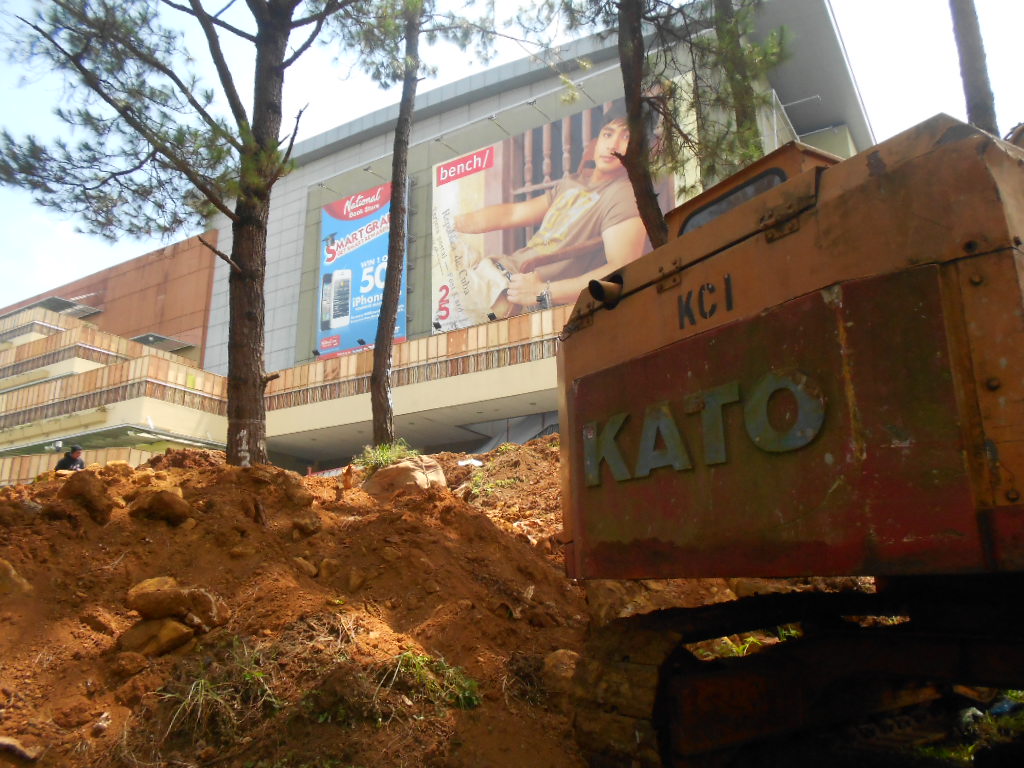
Fact is, Baguio’s natural environment has been under attack. There are less and less earth space in the city, and more and more pavements. There are less and less trees and more and more concrete structures. How far do we want to continue doing nothing before it’s too late? Sadly, as long as our leaders believe that the only road towards progress is by pouring concrete on every available space in the city, the quality of life in the city will continue to deteriorate until we reach the point of no return.
That’s the gist of the battle to save the 182 trees on Luneta Hill– for if the expansion project goes on, if the proponents are allowed to give the trees a virtual death sentence in the name of crass commercialism, then that’s the message that we’re sending to everyone in the community, especially the young: trees are mere obstacles to “development.” But are we really a developed city if we have less of nature and more man-made structures? Are we really better off with more parking lots and commercial buildings than open spaces where God’s creations flourish?
The answer seems to be obvious, which makes one wonder why there are only close 5,000 people during that really to protest SM City Baguio’s expansion project, when there are close to half a million people living in Baguio today. it could be bcause we have been used to quantifying things in terms of objects that are immediately visible, things we can touch, sit on, ride on, eat or eat from. We work hard and we get money in the end. We give that money to a vendor and we get goods in return, right there and then. Enough of us write this politician’s name on a ballot, and that politician sits in power for the next few years.
We don’t get to touch or immediately see the amount of fresh air that we lose every time a tree dies. We don’t see the trees sucking in the toxins from the atmosphere, the way an exhaust fan does to smoke emanating from the stove in the kitchen. We can’t put a price to how much less happy we feel when we’re surrounded by concrete buildings instead of trees.
As for me, I don’t want SM to win the case filed against them. I don’t wish for the court to uphold the permits given to them by our government to go ahead and remove the trees and build their parking lot and mall expansion. And I also don’t want for the complainants to be declared the “winners.” Because what’s at stake here are not any one person’s glory or pride, this battle goes way beyond that. And it's definitely not just about an artificial person's, or a corporation's right to earn as much money as they want. What’s really at stake here is life – the life of those trees that have nurtured the community and defended them from natural disasters for decades, and the quality of life that those trees help provide the human beings who live in this city.
At the end of the day, it’s not simply about being guilty or not guilty, winners and losers – as for me, in this battle, I root for nobody and nothing else but the remaining trees on Luneta Hill.
*my column in the Sept. 23, 2012 issue of Cordillera Today
Friday, September 21, 2012
"SAVE 182 OPEN TO 'AMICABLE SETTLEMENT' AS LONG AS THE TREES ON LUNETA HILL REMAIN WHERE THEY ARE, ALIVE"
SM City Baguio plans to embark on an expansion project that would result in the removal/earthballing and/or cutting of trees on Luneta Hill, an area that springboarded the birth of Baguio as a city and is among the very few remaining forest covers in Baguio’s central business district. On January 20, 2012, thousands of concerned citizens rallied along Session Road to voice their opposition to the project and a month later, on February 27, an environmental case against the expansion project was filed before the sala of Judge Antonio Estevez of Branch 5 of the Baguio Regional Trial Court.
The prosecution has recently rested its case and on September 26, 2012, the defendants, led by SM Development Corporation and its other affiliate corporations, along with their co-defendants – the Department of Public Works and Highways and the Department of Environment and Natural resources, will present their witnesses in court. The case, filed by concerned citizens and organizations of Baguio represented by volunteer lawyers from the National Union of People's Lawyers (NUPL), hopes to save the trees on Luneta Hill which are being threatened by the proposed expansion plan of SM City Baguio.
Recently, the Save 182 movement, the lead convenor of the protest movement, has received reports from various media outfits and personnel that the primary defendant in the case, SMDC, while confident that the court will rule in their favor, is still open to reaching an “amicable settlement” with the complainants. Asked to comment, the movement reiterates that while they or their lawyers have not received any proposal from the defendants with regards to a possible “amicable settlement, “ it has always been open to reaching a compromise with SM City Baguio as long as the trees on Luneta Hill are spared and remain where they are, alive.
In the court-directed mediation sessions conducted between the parties before the trial, the complainants have repeatedly informed the representatives of the defendants of their willingness to consider alternative expansion plans that would spare the trees, but this was rejected by SMDC which considers the removal of the trees as a non-negotiable aspect of their expansion plan. The movement even cited various construction projects in the city that were able to minimize their impact on the city’s already fragile natural environment if only to stress the point that while the movement welcomes development projects in the city, these must not be done at the expense of the environment and the welfare of the greater majority.
The trees are located on a hill in the center of downtown Baguio surrounded by schools, parks and other commercial establishments, and contribute significantly to the absorption of harmful toxins in the air and water runoff in its surrounding areas preventing natural disasters such as floods and landslides.
Save 182 pins its hopes in saving the trees on Luneta Hill in the integrity of the country’s justice system, and believes that the court will rule fairly and justly according to the testimonies and evidences presented with the welfare of the city and its citizens and the rule of law in mind.
----
For further information:
Karlo Marko Altomonte, Save 182
Mobile 09993892563
Email altomonte.projects@gmail.com
Sunday, September 16, 2012
Meet Nathan
*my column in the Sept. 16, 2012 issue of Cordillera Today
At a workshop on garbage held at UP Baguio last August 29, 2012, the issue was tackled intensively but at the end of the day, we still spend astronomical figures to take care of our garbage and we still don’t have a sustainable solution to the city’s problem. But our family wanted so much to address at least our very own household’s waste management issues, so we visited a friend’s house the other day for some help.
Let me introduce you to Nathan Cheng. He did not put up a company, nor did he promise to end the city’s garbage woes. He did not run for any position in the last elections and I don’t think he plans to seek an elective position next year. Besides, even if he harbored any political ambitions, I don’t think he can: he’s only 13 years old. And a few years ago, he came up with the Vermi-Compostable Heterogeneous Organic Waste Bin Recycling System.
Vermi-what? Vermi-C.H.O.W., for short, as he calls his vermicomposting system.
 |
| Nathan Cheng |
At a workshop on garbage held at UP Baguio last August 29, 2012, the issue was tackled intensively but at the end of the day, we still spend astronomical figures to take care of our garbage and we still don’t have a sustainable solution to the city’s problem. But our family wanted so much to address at least our very own household’s waste management issues, so we visited a friend’s house the other day for some help.
Let me introduce you to Nathan Cheng. He did not put up a company, nor did he promise to end the city’s garbage woes. He did not run for any position in the last elections and I don’t think he plans to seek an elective position next year. Besides, even if he harbored any political ambitions, I don’t think he can: he’s only 13 years old. And a few years ago, he came up with the Vermi-Compostable Heterogeneous Organic Waste Bin Recycling System.
Vermi-what? Vermi-C.H.O.W., for short, as he calls his vermicomposting system.
 |
| A recycled plastic container serves as a garbage bin |
 |
| Worm holes: the worms go out at night to secrete waste/compost, then go back in and continue to eat organic waste |
Vermicomposting is the “process of composting using various worms, usually red wigglers, white worms, and earthworms to create a heterogeneous mixture of decomposing vegetable or food waste, bedding materials, and vermicast. Vermicast, also called worm castings, worm humus or worm manure, is the end-product of the breakdown of organic matter by an earthworm. These castings have been shown to contain reduced levels of contaminants and a higher saturation of nutrients than do organic materials before vermicomposting.” (Wikipedia)
 |
| Vermi-C.H.O.W. Bin Recycling System |
What makes the system stand out is its simplicity – it is low-maintenance, very easy to manage and very efficient. The contraption is simple – a basin, a recycled water container in the middle, the biodegradable waste inside that container with some African nighcrawlers (Eudrilus eugeniae) along with it. The worms eat the waste, digest it, and then they get out of the container and use the basin as their toilet. Yup, Nathan’s pets are toilet-trained. The worms’ excretions have been proven to be highly effective as organic fertilizers.
Nathan’s mother, Antonette, showed us how the system works: place the biodegradable waste inside the bin and a few days later, harvest the compost in the basin. When the worms multiply and the bin gets too crowded, set-up another one. It’s that simple.
But does it work? First thing we noticed when we entered their house was how healthy their plants were – they’re all fed with the compost that the system produce. There were no flies hovering around nor was there foul odor emanating from the numerous Vermi-C.H.O.W. systems in place all over: the garage, the porch, out in the garden, up on the roof.
After being gifted with a starter kit, we made our way out and outside their house Nathan’s mother picked up a couple of bags of biodegradable waste left by their gate by their neighbors – Nathan’s system now takes care of all the biodegradable waste of their neighborhood.
Nathan’s system has won numerous awards but have you heard about it? Probably not, for Nathan is not interested in making millions and making others make millions from his invention. Neither will he allow politicians to capitalize on his brainchild to advance their vested interests.
In the meantime, Nathan Cheng, 13, is doing what most of our leaders have failed to do – do what he can to make Baguio a better place for his and future generations.
Saturday, September 8, 2012
One Peter Puzon (and why the crazies have my vote)
During the campaign period of the 2010 elections, a forum for mayoralty candidates was held. All candidates were invited and given the chance to speak about their platforms, except for one Peter Puzon. He filed a complaint before the Commission on Elections, citing the “equal access” provision and the spirit of the Fair Elections Act. His complaint was dismissed for according to the city election officer, the organizers led by the Hotels and Restaurants Association of Baguio did not commit any violation when it excluded him and that their act of omission did not mean that they favored “any group or political party.”
It goes without saying that the powers-that-be in the city dismissed Puzon’s candidacy as a joke. In their eyes, he was a nuisance candidate not worthy of an equal opportunity to present his vision for Baguio.
When the dust settled, Puzon received a measly 66 votes, placing 9th in a field of ten candidates and 47, 308 votes behind frontrunner and eventual winner, Mauricio G. Domogan who may just be remembered for saying he “cannot do anything” to save the trees on Luneta Hill from corporate greed.
After the elections, the candidates submitted their respective election expenses reports which had the top two winners, Mayor Domogan and Congressman Bernardo M. Vergara declaring that they spent less than half a million each, while Puzon pegged his expenses at P200.00. I believe Puzon’s statement, which translated into an average of P3.00 for each vote he received. If we are to believe in the mathematics of politics, had he spent the same amount as our sitting Mayor, and assuming that the close to half a million-peso expense report is true, he would have gotten at least 160,000 votes – more than three times what Mayor Domogan got.
We hardly hear from the eight other candidates these days, as if they can only care about Baguio if they’re in power.
But Peter Puzon, the “nuisance candidate?” You may catch him at the City Council sessions, intently listening to deliberations on important issues that affect the lives of hundreds of thousands of Baguio residents, other times he’s seen handing out photocopies of his very own newsletter containing his stand on various community concerns. I still have his statement on the utterly anti-poor policy of limiting the pedestrian crossings on Session Road to ensure that those who own cars can cruise along the historic road with ease, while those on foot will have to walk the extra hundred meters or so to cross.
In the coming weeks, we will start to hear again from the “genuine” candidates for various positions in the city – it’s election time, time to “care” for the city once again. I don’t know if Peter Puzon, the one whom most pundits dismissed as crazy for running for Mayor, will file his certificate of candidacy this time around, it doesn’t matter for in my eyes, he is the only one from among all the candidates in the 2010 elections who never stopped caring for his city and continued to champion causes he believed in.
Who’s crazy now? Peter Puzon or the ones gave us the Irisan garbage slide that claimed lives and property? Peter Puzon or the ones who wasted millions on inefficient Environmental Recycling System machines? Peter Puzon or the ones who are proposing to turnover the Baguio Athletic Bowl and the Baguo General Hospital to private interests? Peter Puzon or the ones who let corporations lord it over the city these days, raping the environment and wantonly violating the laws of the land and getting away with it?
Peter Puzon never stopped doing something for a better Baguio, as opposed to the ones who have admitted that they “cannot do anything,” and the ones who just stopped caring after losing the election. If they say his kind is crazy, then the crazies will have my vote next year.
Saturday, August 18, 2012
The Bowl Job Blows
*my article in the August 19, 2012 issue of the Cordillera Today
Déjà vu – a couple of years ago, the issue helped bring down a mayor’s bid to move up the political ladder and become the city’s representative in congress. Peter Rey Bautista, then the city’s chief executive, found himself at the receiving end of biting criticism, this paper among the most rabid, over plans to bring in a private partner to rehabilitate and develop the dilapidated Baguio Athletic Bowl.
A local reporter claimed then that it was already a “done deal,” likened to a midnight deal since it was done during the Christmas holidays a few months before the elections, and that lawyer Reynaldo Cortes thought that “the measly lease of P1.2M (a year) is ‘peanuts’,” even with the 10% annual increase after the first five years.
I initially joined the bandwagon then, but I have to admit that my opposition was somewhat tempered when I read through the proposal then – a private company would come in to rehabilitate the facility, including raising the track oval to international standards and improving the grandstand to accommodate up to 20,000 spectators. To recoup their expenses, they would be allowed to operate an athletes’ dormitory, sports shops and food and beverage establishments. The facility would remain free and open to the city’s athletes and for city government-sponsored events.
The fact that that the proposal guaranteed that local athletes would still get to use the upgraded facilities for free made me rethink my opposition, though I agreed with Atty. Cortes’ assertion that P100,000 a month was quite disadvantageous to the government.
Bautista gave in to the public outcry then, and shelved the idea. But now the proposal is being revived. Councilor Edison Bilog is today’s lead oppositor up there in City Hall. An online word war is in the offing between him and Councilor Richard Cariño, among those siding with the proposal to privatize the Baguio Athletic Bowl.
The Terms of Reference (TOR) has been posted online for everyone to scrutinize and I have and I don’t buy it.
First, it is not clear whether the local government can actually enter into such deals – the Baguio Athletic Bowl is within Burnham Park, and for crying out loud, as we have been doing every time various parts of the park is turned into a tiangge such the Market Encounter during Panagbenga season, it must be beyond the commerce of man. Besides, can the Baguio City Government, without authorization from the national government, really enter into such contracts involving Burnham Park?
Secondly, our leaders must stop viewing anything that benefits the greater majority as merely an added expense that the city must be able to recoup. A park is an invaluable service that the government must spend for, and the ROI the that city gets from it is far more valuable than whatever amount commercializing it brings: a happy, healthy citizenry that’s able to escape life’s challenges without having to cough up precious, hard-earned money for a chance to simply exhale once in a while. We cannot keep on saying that that we don’t have money for something that will benefit the masses while at the same time throwing away more than a hundred million for useless ERS machines that failed to make a significant dent in our search for a solution to the garbage problem.
To me, privatization is a paradox. The government privatizes primarily due to lack of funds. But then private companies enter into these contracts with the government because the venture is profitable. So, even if I believe that ROI should not be an issue in rehabilitating the Baguio Athletic Bowl, if they indeed believe that the development of the Baguio Athletic Bowl is a profitable venture, why doesn’t our local government just do it itself? No money for it? Come on! Again, we can easily spend more than P100M for ERS machines that didn’t serve its purpose. We can spend millions on unnecessary road repairs. We can spend millions on “park improvements” that actually diminish the aesthetic value of the place rather than enhance it. Heck, not too long ago, we spent millions for a stupid concrete pine tree!
Having said all that, I say no to the privatization of the Baguio Athletic Bowl. It just blows.
Saturday, August 11, 2012
On a day such as this
There were no guarantees I'd make it there – news reports the previous night showed the North Luzon Expressway (NLEX) to be impassable due to flooding in various portions of the highway. When the following morning’s news reports and social media updates showed that the floods along the Manila-Central/Northern Luzon highway link have receded, and because of an unavoidable appointment last Wednesday, I braved the torrential rains and got on a bus to Manila having no idea if I can get to my destination from wherever the bus could take us.
The bus ride went along rather smoothly until we got to NLEX when heavy rains resulted in almost zero-visibility. Luckily we reached the Cubao station without any incident – and there the adventure began. It was half past three in the afternoon, and I was scheduled to meet a client in an hour in Pasay. My best bet to make it on time was to take the MRT, and the nearest station was merely a hundred meters or so away. But the rain was so strong that a few seconds under it would leave you completely drenched, so walking those hundred meters was out of the question. Besides, I couldn’t even get out of the bus station on t the street because the area was flooded.
15 minutes passed, then I decided to just wade in and get on the nearest bus to get to the MRT station. That short bus ride took half an hour. Five minutes later and I was on an elevated railway on a train making its way through the rain to Pasay. Another 15 minutes and we arrived at the Pasay-Rotonda station. I got off and made my way down to take whatever mode of transportation would be available to take me to my destination, which on a normal day would have been merely five minutes away - and I had 25 minutes left.
A crowd of people gathered at the bottom of the steps – there, floodwaters reached up to above the knees. Jeepneys would back all the way up the sidewalk to right infront of the MRT station steps so passengers can hop in without getting wet. Pedicabs offered passage to just a few meters to the other side of the road for P100.00. I hopped on a jeep, arrived at my destination, met with the client and quickly concluded our business transaction and called my daughter who was staying in a dormitory near her school, St. Benilde along Singalong St. near Taft Avenue - an area notorious to get underwater at the slightest downpour.
The rain has stopped, and another jeep ride and several flooded streets later and my daughter and I were merely some steps away from each other at the corner of Vito Cruz and Taft Ave., separated by a sea of murky and debris filled- waist-high floodwater. So near and yet so far. My daughter got on a pedicab and after having dinner together and knowing that she’s safe where she was, I walked her back to the edge of the flood, negotiated with a pedicab driver to take her back to her dormitory. I did notice that while the flooding in some areas slightly receded when the rain stopped, the water level in others remained as they were – clogged drainage systems and canal were clearly the culprit.
The rains fell again as soon as the pedicab disappeared from view. I called my daughter to check if she made it back safely, and she did, so I made my way back to the bus station in Pasay. This time it wasn’t as easy. The rain has started pouring again which made the floodwaters rise again and now there were less jeepneys on the road. After a combination of several short jeep rides and balancing acts on whatever elevation the sidewalks of F.B. Harrison St. offered, I made it to EDSA. I decided to walk the rest of the way to the station.
After making it to the other side of Taft Ave., merely a few meters away from the bus station, I saw blinking lights in the distance approaching. A couple of motorcycle-riding policemen, imposing SUVs with tinted windows, and it became obvious that this was probably the president’s convoy.
One support vehicle veered a little too close to the side of the road, splashing water on me and other pedestrians who didn’t have the luxury of not having to walk the streets on a day such as this.
Saturday, August 4, 2012
The whole truth
My article in the August 5, 2012 issue of Cordillera Today
The Save 182 movement stipulated in court that several protest actions prove that the community is against the removal of trees on Luneta Hill to pave the way for SM City Baguio’s expansion project. The highly-paid lawyers of SM, together with the people’s taxes-paid lawyers for DENR and DPWH, denied it, so we endeavored to prove our claim.
I took the witness stand last week to testify on the community’s opposition to the expansion project of SM City Baguio. I brought with me video footage and photos documenting the various rallies and other protest actions against SM City Baguio, but the court and the defense lawyers prevented me from presenting these, citing various technicalities. I can’t help but be reminded of the infamous brown envelope that brought Joseph Ejercito down.


A couple of weeks later, on February 5, 2012, a tree planting activity and concert dubbed “Pine for Pine” hand more than a thousand Baguio lovers planting trees at the Pine Trees of the World Park and more than a hundred local and nationally-renowned artists performing in a concert that was held in protest of the expansion project.


That several public demonstrations were held thereafter.


I hereby swear that all of the above information is the truth, the whole truth and nothing but the truth to the best of my knowledge and belief.
So help Baguio, Kabunyan.
*with photos courtesy of Jojo Lamaria
The Save 182 movement stipulated in court that several protest actions prove that the community is against the removal of trees on Luneta Hill to pave the way for SM City Baguio’s expansion project. The highly-paid lawyers of SM, together with the people’s taxes-paid lawyers for DENR and DPWH, denied it, so we endeavored to prove our claim.
I took the witness stand last week to testify on the community’s opposition to the expansion project of SM City Baguio. I brought with me video footage and photos documenting the various rallies and other protest actions against SM City Baguio, but the court and the defense lawyers prevented me from presenting these, citing various technicalities. I can’t help but be reminded of the infamous brown envelope that brought Joseph Ejercito down.
Our lawyer then tried to have me testify on the heritage of the city including Luneta Hill. But again, the court and the defense lawyers dismissed whatever I could’ve said on the stand as hearsay, being mainly based on research and studies I made in the production of the video documentary on the history of Baguio City, “Portrait of a Hill Station.” That documentary has been endorsed by the Baguio Historical Society.
Essentially, they claimed that I cannot possibly testify on the history of Baguio City since I wasn’t personally there during the time of Baguio’s genesis as a city. So if any of you know of anyone who was present when Luke E. Wright and Dean Worcester surveyed Kafagway in 1900, please let us know.
They asked me to swear to tell the truth, the whole truth then proceeded to prevent the same from being heard in court.
They asked me to swear to tell the truth, the whole truth then proceeded to prevent the same from being heard in court.
The testimony that I wasn’t able to present in court, I hereby present to you, the people:
That based on various historical documents, Luneta Hill was the site of the very first structure that the Americans erected in preparation for Kafagway’s transformation into the City of Baguio. That after putting up a sanitarium on Luneta Hill, the city’s pioneers made efforts to beautify the area by planting flower gardens and trees some of which, based on their age, are among the trees that SM intends to uproot for their concrete structure. Luneta Hill, and the trees thereon, are very much part of the city’s heritage, and thus must be protected, defended and preserved.
That on January 20, 2012, thousands of residents took to the streets to voice out their opposition to the project.


On Valentine’s Day, hundreds lit candles and joined hands and marched around SM City Baguio during “Jericho Walk” chanting “Boycott SM!”


That several public demonstrations were held thereafter.


And on the night of April 9, 2012, SM started uprooting trees on Luneta Hill, which enraged concerned citizens who marched to Luneta Hill the following morning in protest. During that rally in the morning of April 10, 2012, our lawyers announced to the public that a Temporary Environmental Protection Order has been issued by the court but SM City Baguio refused to accept or acknowledge it. That same evening, they continued removing trees on Luneta Hill.
That on April 11, 2012, various groups called for an assembly at the Baguio Cathedral grounds to protest SM City Baguio’s brazen defiance of the court order. Once again, numbering several thousands, the group marched to Luneta Hill to reiterate the community’s opposition not only to the expansion project but to SM’s utter disregard for the law.
I hereby swear that all of the above information is the truth, the whole truth and nothing but the truth to the best of my knowledge and belief.
So help Baguio, Kabunyan.
*with photos courtesy of Jojo Lamaria
Subscribe to:
Posts (Atom)
-
 Right before the recent elections, I received a text message from Sister Fidelis, an Assumption nun and one of the staunch supporters of the...
-
We heard that there's a new guy on top of the Baguio City Police Office, I just hope he can do something about these clowns: You can...